
How often \"Dear Mr\" reaches a woman: salutation errors from first names in 10 countries
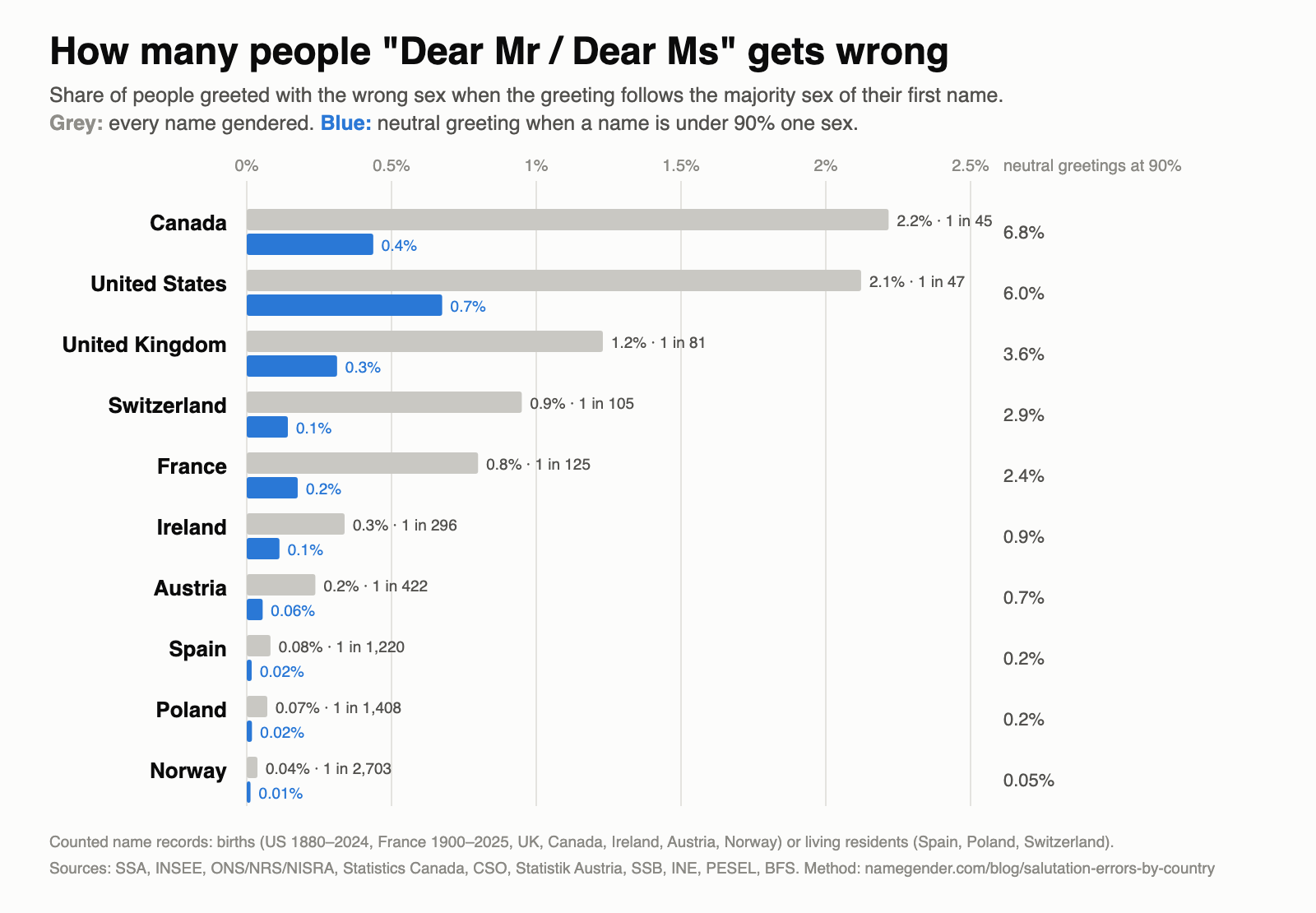
If you write "Dear Mr" or "Dear Ms" based only on the first name, you will greet about 1 in 47 Americans as the wrong sex. In Canada it is 1 in 45, in the United Kingdom 1 in 81, in France 1 in 125. In Spain, Poland and Norway the same method gets it wrong for fewer than 1 in 1,000 people. The difference is not the quality of the guess; it is how many first names in each country are shared by both sexes.
Falling back to a neutral greeting when a name is less than 90% one sex cuts those errors by about two-thirds or more in every country: to 1 in 148 in the US and 1 in 568 in France. The cost is that some people get the neutral greeting: 6% in the US, 2.4% in France, and 0.2% or less in Spain and Poland.
The figures come from official name counts in ten countries, the same records behind our salutation API and name gender API. They were computed on 13 October 2026.
How we counted
For each country we took every counted name record: a registered birth in the US (1880–2024), France (1900–2025), the UK, Canada, Ireland, Austria and Norway, and a living resident in Spain, Poland and Switzerland, where that is what the statistics office publishes.
Each person is greeted by the majority sex of their first name in their own country. Someone named Jordan in the US, where 75% of Jordans are boys, gets "Mr". A person is misaddressed if they belong to the minority: in this case, the 25% of Jordans who are girls.
Then we added a rule that a careful sender would use: if a name is less than a given share one sex, use a neutral greeting instead. We tried thresholds of 80%, 90%, 95% and 99%.
| Country | Every name gendered | Neutral below 90%: misaddressed | Neutral below 90%: neutral greetings |
|---|---|---|---|
| Canada | 2.2% (1 in 45) | 0.44% | 6.8% |
| United States | 2.1% (1 in 47) | 0.68% | 6.0% |
| United Kingdom | 1.2% (1 in 81) | 0.31% | 3.6% |
| Switzerland | 0.95% (1 in 105) | 0.14% | 2.9% |
| France | 0.80% (1 in 125) | 0.18% | 2.4% |
| Ireland | 0.34% (1 in 296) | 0.11% | 0.86% |
| Austria | 0.24% (1 in 422) | 0.06% | 0.69% |
| Spain | 0.08% (1 in 1,220) | 0.02% | 0.25% |
| Poland | 0.07% (1 in 1,408) | 0.02% | 0.18% |
| Norway | 0.04% (1 in 2,703) | 0.01% | 0.05% |
Spain and Norway publish only names above a minimum count, so their rarest names, which are more often mixed, are missing. Their figures are lower bounds.
The names behind the errors
In most European countries, a handful of names produce most of the mistakes:
- France: Dominique alone accounts for 24% of all wrong greetings (41% of Dominiques are women), Camille for 12% and Claude for 8%. Three names, 44% of the errors.
- Switzerland: Andrea causes 10% of all wrong greetings. In German it is a woman's name, in Italian a man's, and Switzerland has both languages: 24% of Swiss Andreas are men. Michele, Gabriele, Daniele and Simone are the same story: Italian men's names that look feminine to a German reader. "Sehr geehrte Frau Andrea Bernasconi" reaches a man more often than you would think.
- Norway: Kim accounts for 36% of all wrong greetings. It is 93% male in Norway, where it is a traditional man's name.
- Austria: Nikola, Dominique, Nicola and Deniz lead. Deniz is a Turkish unisex name, 14% female in Austrian records.
- Spain: Andrea is 97% female in Spain, but it is so common that its 3% of men are the largest single source of wrong greetings. Marian (37% female) is next.
In the US and Canada the errors are spread out. The worst name in the US, Willie, causes only 1.9% of all wrong greetings, followed by Jordan, Taylor, Leslie, Jessie and Riley. There is no short list to fix by hand. That is why the American rate stays at 0.68% even with the 90% rule: thousands of names that are "mostly one sex" still carry a minority. Shawn, Cameron and Logan are each more than 90% boys and each has more than 30,000 girls in the US records.
What a stricter threshold buys
| Threshold | US misaddressed | US neutral | France misaddressed | France neutral |
|---|---|---|---|---|
| none | 2.12% | 0% | 0.80% | 0% |
| 80% | 1.07% | 3.4% | 0.31% | 1.4% |
| 90% | 0.68% | 6.0% | 0.18% | 2.4% |
| 95% | 0.49% | 8.6% | 0.12% | 3.2% |
| 99% | 0.28% | 18.4% | 0.05% | 7.6% |
Each step costs more neutral greetings than it saves wrong ones. Going from 90% to 99% in the US removes 0.4 percentage points of errors and adds 12 points of neutral greetings. The right point depends on what a mistake costs you. For a newsletter, 90% is a reasonable default. For a letter to a customer who has complained, a neutral greeting is cheap and a wrong one is not.
The neutral greeting differs by language
A neutral greeting is not always the same sentence with the title removed. Each language has its own:
| Language | Gendered | Neutral |
|---|---|---|
| English | Dear Ms Smith, | Dear Alex Smith, |
| German | Sehr geehrte Frau Müller, | Guten Tag Alex Müller, |
| French | Madame, | Madame, Monsieur, |
| Spanish | Estimada Sra. García: | Hola, Alex García: |
| Polish | Szanowna Pani, | Szanowni Państwo, |
| Italian | Gentile Sig.ra Rossi, | Gentile Alex Rossi, |
| Dutch | Geachte mevrouw De Vries, | Geachte Alex de Vries, |
| Turkish | Sayın Ayşe Hanım, | Sayın Ayşe Yılmaz, |
Turkish and Italian have an easy way out: "Sayın" and "Gentile" carry no gender, so the neutral form reads as a normal formal greeting. French and Polish fall back to the plural form used when the recipient is unknown, which is correct but impersonal.
How the API handles this
Our salutation endpoint uses the same rule as this analysis. It looks up the first name with the country you give, and writes a gendered greeting only if the name is at least 90% one sex in that country's records. Below that it returns the neutral form and says why (below_min_probability). You can raise or lower the threshold per request with min_probability, or ask for the neutral form outright.
The country matters as much as the threshold. Andrea in Switzerland is 76% female; in Italy it is a man's name; in Spain it is 97% female. A greeting written without the country is a guess about which of those people you are writing to.
Reproducing it
The script is scripts/salutation-errors.php. It reads the counted name records from our database and writes one JSON file with every country's error rates at each threshold, the names behind the errors, and the strongly gendered names that still produce them. scripts/salutation-errors-chart.mjs draws the chart from that file.
Related: unisex names by country, names that change gender from one country to the next, and the name profiles for Andrea, Dominique, Kim and Jordan.
Every claim on this page is measurable against your own list. The free tier is enough to check it.
Related
-
Boys' names that became girls' names: 145 years of US birth records
56 common US first names switched sex between 1880 and 2024: 48 went from boys to girls, only 8 the other way. Leslie, Ashley, Morgan, Kyrie and more.
-
Do names come back after 100 years? We measured it in the US and France
Names that return do so about a century after their first peak: a median of 97 years in the US and 86 in France. Next in line: June, Ruth, Suzanne, Marcel.
-
French names that changed sex: why it almost never happens, and why Camille is
In 125 years of French births only 5 common names switched sex, against 56 in the US. Camille is the biggest, and it is now switching back to boys.