
French names that changed sex: why it almost never happens, and why Camille is
French first names almost never change sex. Of the 1,380 names given to at least 4,750 French babies since 1900, only 5 went from under 30% girls in one decade to over 70% in another, or the reverse. In the United States, the same rule applied to 145 years of birth records finds 56 such names out of 1,846: Leslie, Ashley, Morgan and the rest. That is 0.4% of common names in France against 3.0% in the US.
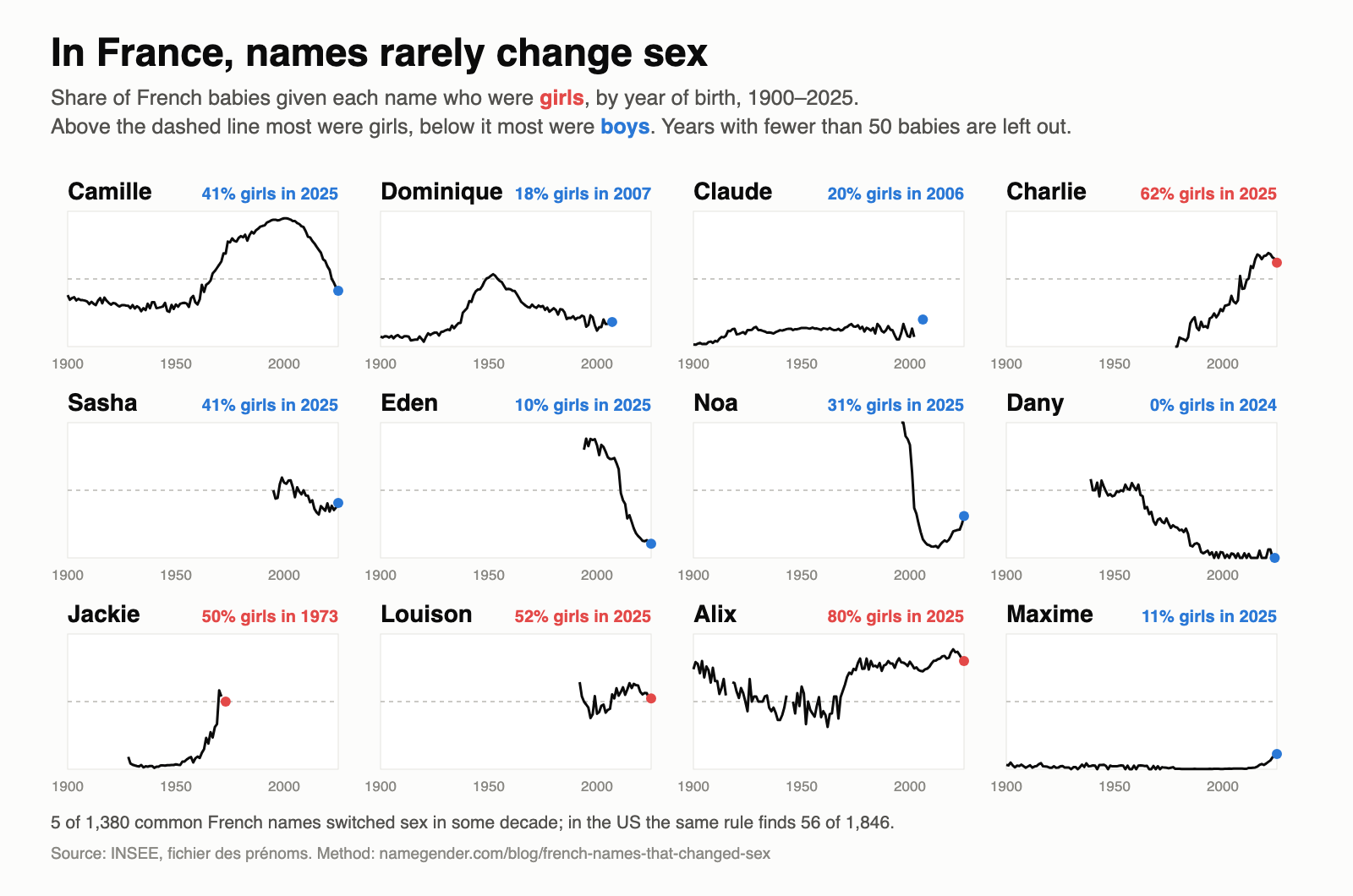
The biggest French exception is Camille, and it is now reversing. Camille was a mostly male name until the 1960s, peaked at 95% girls in 2000, and in 2025 was given to more boys than girls again: 41% of the 1,555 Camilles born in 2025 were girls.
The figures come from INSEE's fichier des prénoms, which counts every first name given to French babies from 1900 to 2025. It is the same source behind the French figures in our name gender API. They were computed on 13 October 2026.
The rule, and why the thresholds differ from the US
We used the method from the US article: add years up into decades, and call a name switched if it was under 30% girls in one decade and over 70% girls in another. France records far fewer births than the US (87.6 million in the INSEE file against 371.9 million in the SSA files, about 4.2 times fewer), so the thresholds are scaled by the same factor. A French name needs 4,750 babies overall instead of 20,000, and a decade counts when it has at least 120 babies instead of 500.
INSEE publishes every count rounded to a multiple of five. That makes no difference to names given to thousands of babies, but it is why small yearly numbers in this article all end in 0 or 5.
The five that switched
| Name | Direction | Babies, 1900–2025 | What happened |
|---|---|---|---|
| Camille | to girls, now back | 292,690 | 29% girls in the 1930s and 1940s, 93% in the 1990s and 2000s, 41% in 2025 |
| Noa | to boys | 41,935 | 84% girls in 2000, 19% in 2005 |
| Eden | to boys | 41,635 | 87% girls in 1998, 10% in 2025 |
| Jackie | to girls | 19,415 | 5% girls or fewer in the 1930s to 1950s, 94% in the 1980s on far smaller numbers |
| Mary | to girls | 6,930 | 28% girls in the 1900s, 99% from the 1970s |
Two of the five, Jackie and Mary, are English names that were rare in France in both of their phases. The three that matter are Camille, Noa and Eden, and two of those three went toward boys, the opposite of the American pattern.
Noa is the fastest change in either country. In 2000, 84% of the 305 Noas born in France were girls. Five years later the name was given to 2,290 babies and 81% of them were boys. Eden followed more slowly: two-thirds girls in 2010, and 90% boys among the 2,585 Edens born in 2025.
Charlie just misses the list. It went from 13% girls in the 1980s to 66% in the 2020s, and was given to 2,765 babies in 2025, 62% of them girls. If it keeps its direction for another decade it will be the sixth.
Camille: the round trip
Camille was a boy's name for the first half of the century, with roughly a third of the babies girls: 38% in 1900, 31% in 1960. In the 1970s it crossed to the girls' side, and by the late 1990s it was one of the most common girls' names in France, with 7,965 babies in 1998 alone, 94% of them girls.
Then it came back. 74% girls in 2015, 59% in 2020, 47% in 2023, 44% in 2024 and 41% in 2025. It is by far the largest name in either country to make that round trip. In the US only much smaller names have done it, such as Kerry, Pat and Elisha, while the big ones that are drifting back, Morgan and Taylor, still have more girls.
Anyone looking up "Camille" therefore gets a different answer depending on when the person was born. A Camille born in 1940 was probably a man, one born in 1998 almost certainly a woman, and one born in 2025 slightly more likely a boy.
Why French names stay put
Spelling carries the sex. French has a written feminine for most male names, and parents use it. René was given to 516,595 babies and Renée to 221,730. The first is 99.9% boys, the second 100% girls, though the two are pronounced the same. The same holds for every pair we checked:
| Masculine | Babies | Feminine | Babies |
|---|---|---|---|
| Michel | 820,690 | Michèle | 180,285 |
| René | 516,595 | Renée | 221,730 |
| Daniel | 437,855 | Danielle | 158,075 |
| Frédéric | 328,090 | Frédérique | 50,335 |
| Pascal | 307,935 | Pascale | 102,555 |
| Gabriel | 212,030 | Gabrielle | 104,325 |
| Joël | 146,615 | Joëlle | 93,685 |
| Noël | 51,765 | Noëlle | 28,205 |
In each pair the masculine spelling is at least 99.8% boys and the feminine at least 99.4% girls. When an American family gives a boy's name to a girl, it usually keeps the spelling, and over a generation the name moves. A French family adds an e, and the masculine name stays masculine.
The law limited the choice until 1993. From 1803 until the law of 8 January 1993, French parents were in principle expected to choose names from saints' calendars and known historical figures, and registrars could refuse others. The names that have moved since are almost all recent arrivals: Noa, Eden, Sasha, Louison and Charlie barely appear in the records before the 1990s. The data cannot say that the law caused this, but the timing fits.
The names that stayed in the middle
France has had genuinely mixed names; they just stayed mixed rather than moving. Dominique was the largest: 409,980 babies, and in its peak decade, the 1950s, 188,880 of them, 48% girls. Its share of girls never went above 54% in any year, and the name has faded since rather than settled on one sex. Claude, often thought of as unisex, never was in the counts: 12% girls over its whole history.
The current mixed names are newer and smaller: Charlie (62% girls in 2025), Louison (52%), Sasha (41%) and Alix, which is one of the oldest, at 74% girls in the 1900s and 80% in 2025.
What this means for gender lookups
For most French first names, the written form settles the question, more firmly than in English. Our French data returns Michèle, Pascale and Danielle as female and their masculine forms as male, with hundreds of thousands of recorded births behind each answer.
The names to treat with care are the few that moved or stayed mixed: Camille, Dominique, Eden, Noa, Charlie, Sasha, Louison, Alix. For these, the API reports the share and the number of records behind the answer, and a lower share is the signal to check. If you know roughly when the person was born, our age distribution for each first name uses the same French records.
Reproducing it
The script is scripts/names-that-switched-fr.py. It reads INSEE's national file (prenoms-2025-nat.csv) and writes one JSON file with every switched and mixed name, the spelling pairs and the yearly series behind the chart. The chart is drawn from that file by scripts/names-that-switched-chart.mjs, the same script as for the US article. INSEE groups rare names under _PRENOMS_RARES; those rows are left out.
Related: boys' names that became girls' names in the US, unisex names by country, and the name profiles for Jean, Dominique and Sasha.
Every claim on this page is measurable against your own list. The free tier is enough to check it.
Related
-
Boys' names that became girls' names: 145 years of US birth records
56 common US first names switched sex between 1880 and 2024: 48 went from boys to girls, only 8 the other way. Leslie, Ashley, Morgan, Kyrie and more.
-
Do names come back after 100 years? We measured it in the US and France
Names that return do so about a century after their first peak: a median of 97 years in the US and 86 in France. Next in line: June, Ruth, Suzanne, Marcel.
-
Alexa, Siri, Tesla: what happens to a baby name when it becomes something else
Alexa was given to 6,052 American girls in 2015 and 348 in 2024. US birth records 2000–2024 for names that became products, news events or screen characters.