
Do names come back after 100 years? We measured it in the US and France

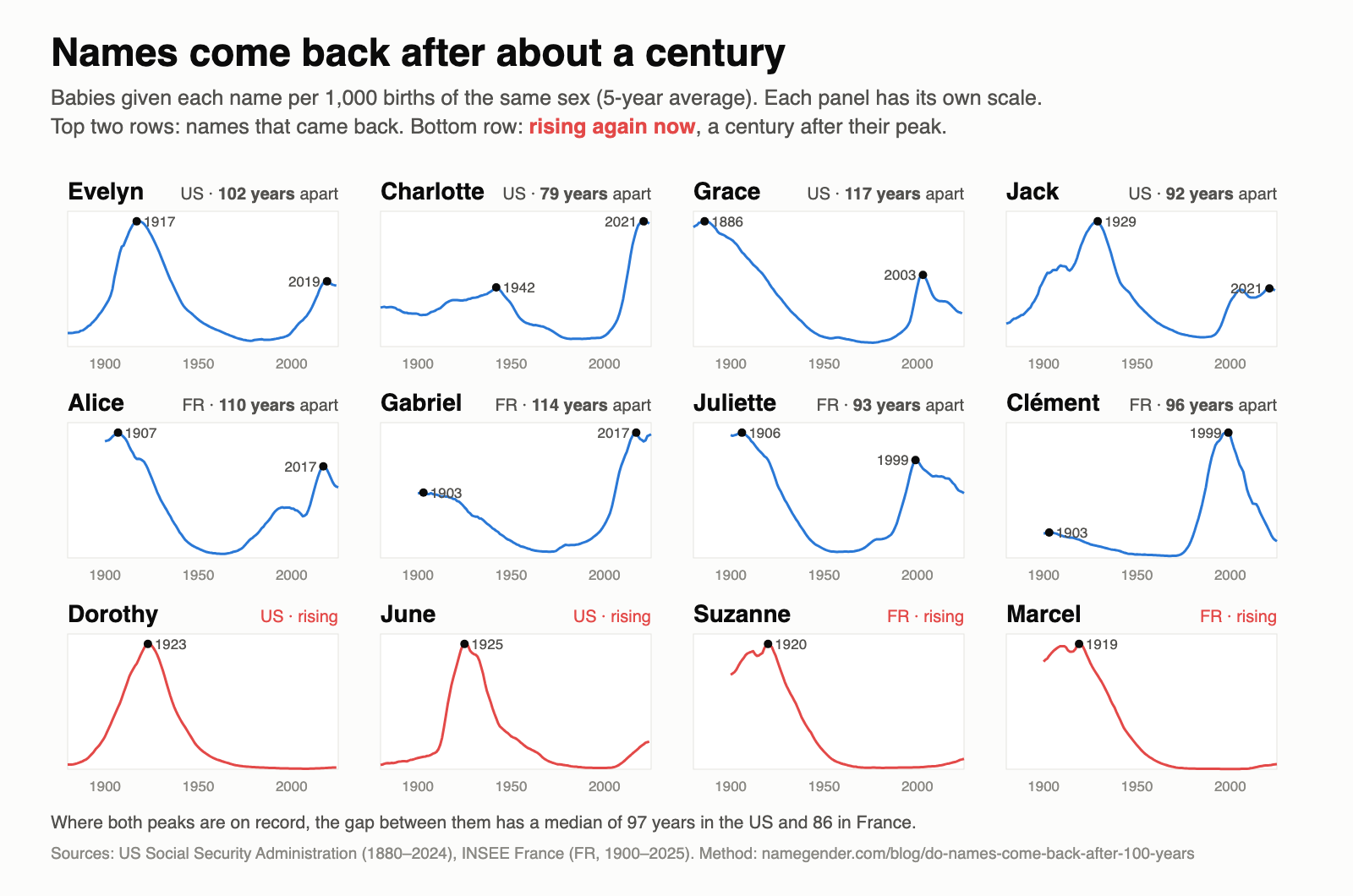
The "100-year rule" for baby names roughly holds. When a first name that had faded comes back, the second peak arrives about a century after the first: a median of 97 years in the United States and 86 years in France, counting every name where both peaks are on record. Half of the American gaps fall between 85 and 115 years.
Evelyn peaked in the US in 1917 and again in 2019, 102 years later. Jack peaked in 1929 and in 2021. In France, Alice peaked in 1907 and in 2017, Gabriel in 1903 and in 2017. And the next round has started: June, Harvey, Frances and Dorothy in the US, and Suzanne, Madeleine, Marcel and Georges in France, all at their highest around 1920, now each take more than twice the share of births they took ten years ago.
The figures come from US Social Security Administration birth records for 1880–2024 and INSEE's French records for 1900–2025, the same counts behind our name gender API and our age from name API. They were computed on 13 October 2026.
What counts as a comeback
For every name and sex we took the share of that year's births of the same sex, smoothed over five years so a single odd year does not make a peak. A name came back if:
- it had a real first peak, at least 1 in 1,000 babies of its sex;
- it then fell to a fifth of that peak or less;
- and it later climbed back to at least two-fifths of the first peak.
The gap is the number of years between the two peaks. The rule finds 63 comebacks in the US and 67 in France.
Two things make many of those gaps uncertain, and we left those names out of the median:
- The first peak is at the start of the records. The US data begins in 1880 and the French in 1900. A name already at its highest in 1880, such as Emma, Sarah or Amanda, probably peaked earlier, so its real gap is longer than we can measure. That excludes 27 American and 49 French names.
- The second peak may still be ahead. Oliver, Theodore, Hazel, Violet and Eleanor in the US, and Marceau and Victoire in France, were still rising in the latest years. Their gaps so far are already 105 to 141 years.
That leaves 24 American and 15 French comebacks with both peaks on record. Their median gaps are 97 and 86 years.
The comebacks with both peaks on record
| Name | Country | First peak | Low point | Second peak | Gap |
|---|---|---|---|---|---|
| Evelyn | US | 1917 | 1978 | 2019 | 102 years |
| Grace | US | 1886 | 1976 | 2003 | 117 years |
| Jack | US | 1929 | 1985 | 2021 | 92 years |
| Charlotte | US | 1942 | 1982 | 2021 | 79 years |
| Audrey | US | 1928 | — | 2014 | 86 years |
| Stella | US | 1884 | — | 2020 | 136 years |
| Sadie | US | 1887 | — | 2015 | 128 years |
| Vivian | US | 1921 | — | 2017 | 96 years |
| Alice | France | 1907 | 1964 | 2017 | 110 years |
| Gabriel | France | 1903 | 1970 | 2017 | 114 years |
| Juliette | France | 1906 | 1957 | 1999 | 93 years |
| Clément | France | 1903 | 1967 | 1999 | 96 years |
| Charlotte | France | 1907 | — | 1988 | 81 years |
| Aurélie | France | 1903 | — | 1983 | 80 years |
The low points are often very low. Evelyn fell from 11.6 per 1,000 American girls in 1917 to 0.5 in 1978. Gabriel fell from 7.8 per 1,000 French boys to 0.7. The names did not just become less common; for a generation they nearly disappeared.
A few short cycles also pass the rule, and they look different. Roosevelt peaked in 1905 and again in 1934, 29 years apart, with two presidents of that name. Bob peaked in 1934 and briefly again in 1960. These follow events, not generations, and they are why we report the median rather than the average.
Charlotte is the same name in both countries but not the same story. In France it came back in the 1980s, 81 years after its first peak; in the US its first peak was smaller and later, in 1942, and its second, in 2021, was twice as high.
Why about a century
The data shows when names return, not why, but the timing points to one explanation that is often given: parents avoid the names of their parents' generation and are drawn to those of their great-grandparents'. At 25 to 35 years a generation, three generations is 75 to 105 years. A name given to a parent sounds old, a name given to a grandparent sounds very old, and a name given to a great-grandparent, whom the parents may not have known, sounds fresh.
We have no firm explanation for France's shorter median. Part of it is which names can be measured: the French records start in 1900, so most measurable French comebacks are names that peaked just after 1900 and returned in the 1980s and 1990s.
Girls' names come back more often
44 of the 63 American comebacks are girls' names, and 39 of the 67 French ones. Boys' names in both countries tend to be steadier: John, William, James, Louis and Pierre were never rare enough for long enough to come back. Girls' names rise and fall faster, so more of them fall low enough to return.
Who is next
These names peaked between 1915 and 1945, almost disappeared, and have grown their share of births at least one and a half times over roughly the past ten years; most have more than doubled it. None is yet back to two-fifths of its old peak, so none counts as a comeback yet.
| United States | Peak | Babies in 2024 | France | Peak | Babies in 2025 | |
|---|---|---|---|---|---|---|
| June | 1925 | 1,956 | Suzanne | 1920 | 720 | |
| Ruth | 1917 | 1,767 | Lucien | 1920 | 755 | |
| Harvey | 1920 | 1,441 | Marcel | 1919 | 585 | |
| Warren | 1922 | 1,327 | Madeleine | 1918 | 485 | |
| Lucille | 1916 | 1,151 | Henri | 1918 | 390 | |
| Rosemary | 1929 | 1,037 | Georges | 1919 | 305 | |
| Frances | 1918 | 821 | Aimée | 1916 | 170 | |
| Dorothy | 1923 | 714 | Colette | 1938 | 170 |
Ruth, Lucille, Lucien and Henri grew more slowly than the rest, by 1.6 to 1.9 times; the others at least doubled. Some of these will stall, as names often do. But if the century rule holds, the 2020s are when the names of the 1920s should return, and these are the ones already moving.
What a comeback does to a name's age
A comeback name belongs to two generations at once. Among living Americans named Evelyn, many are in their eighties and many are children, and very few are in between. A single average age for Evelyn describes almost nobody. That is why our age estimates report the spread of birth years for a name, not just the middle, and why a comeback name gets a wide range.
For gender, comebacks change nothing: Evelyn, Alice and Gabriel came back as the same sex they were. The names that changed sex are a different list; see boys' names that became girls' names and French names that changed sex.
Reproducing it
The script is scripts/comeback-names.py. It reads the SSA yearly files and INSEE's national file and writes one JSON file with every comeback, the names still rising, the "next in line" list and the series behind the chart, which scripts/comeback-names-chart.mjs draws. Norway's yearly name statistics start in 1945, too late to see a first peak around 1920, so Norway is not included here.
Every claim on this page is measurable against your own list. The free tier is enough to check it.
Related
-
Alexa, Siri, Tesla: what happens to a baby name when it becomes something else
Alexa was given to 6,052 American girls in 2015 and 348 in 2024. US birth records 2000–2024 for names that became products, news events or screen characters.
-
Boys' names that became girls' names: 145 years of US birth records
56 common US first names switched sex between 1880 and 2024: 48 went from boys to girls, only 8 the other way. Leslie, Ashley, Morgan, Kyrie and more.
-
French names that changed sex: why it almost never happens, and why Camille is
In 125 years of French births only 5 common names switched sex, against 56 in the US. Camille is the biggest, and it is now switching back to boys.