
Boys' names that became girls' names: 145 years of US birth records

When an American first name changes sex, it almost always goes from boys to girls. Across 145 years of US birth records, 56 common names went from under 30% girls in one decade to over 70% in another, or the reverse. 48 of them moved toward girls. Only 8 moved toward boys, and most of those 8 are short forms like Jan, Donnie and Robbie rather than full names.
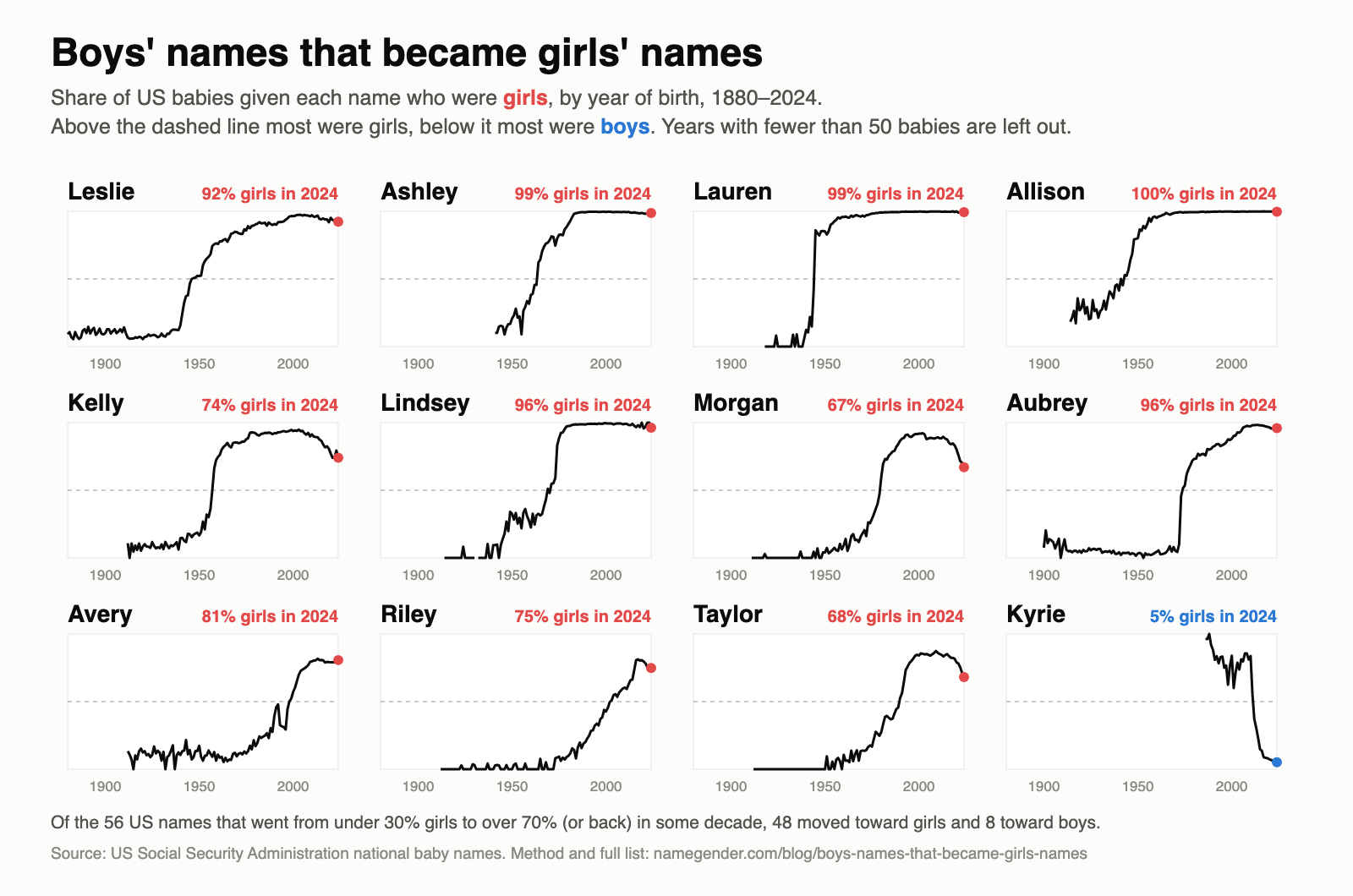
Leslie was a boy's name for its first 60 years on record: in the 1920s, 92% of the 16,306 Leslies born were boys. By the 2000s, 97% were girls. Ashley went from 13% girls in the 1940s to 98.5% in the 1980s, when 357,406 babies were given it. Aubrey stayed under 6% girls for six decades and then crossed to the girls' side in a single one.
The figures below come from the US Social Security Administration's national baby name files for 1880–2024, the same counted records behind the US numbers in our name gender API. They were computed on 13 October 2026.
What counts as a switch
The SSA publishes, for every year since 1880, how many boys and how many girls were given each name, for every name given to at least five babies of one sex. We added the years up into decades and kept a decade for a name only when at least 500 babies were born with it in that decade. We looked only at names given to at least 20,000 babies over the whole period.
A name switched if it was under 30% girls in at least one of those decades and over 70% girls in another. The direction is whichever state came first. The "flip year" in the table is the last year in which the yearly share crossed 50%, counting only years with at least 100 babies, so a name that wobbled around the middle before settling is dated by when it finally settled.
The thresholds are deliberately wide. A name that drifted from 40% to 60% girls is not counted. Every name below changed from mostly one sex to mostly the other.
The names that went to girls
The largest of the 48, by the number of babies who have had the name:
| Name | Mostly boys in | Mostly girls by | Flip year | Girls in 2024 | Babies, 1880–2024 |
|---|---|---|---|---|---|
| Ashley | 1940s | 1970s | 1964 | 99% | 873,769 |
| Kelly | 1910s | 1960s | 1957 | 74% | 555,972 |
| Lauren | 1920s | 1940s | 1945 | 99% | 480,573 |
| Taylor | 1910s | 1990s | 1990 | 68% | 442,358 |
| Madison | 1910s | 1980s | — | 99% | 422,419 |
| Leslie | 1880s | 1960s | 1946 | 92% | 382,963 |
| Allison | 1910s | 1950s | 1946 | 100% | 320,289 |
| Tracy | 1910s | 1960s | 1954 | 67% | 312,766 |
| Courtney | 1920s | 1970s | 1962 | 72% | 281,304 |
| Morgan | 1910s | 1980s | 1980 | 67% | 267,714 |
| Riley | 1910s | 2010s | 2003 | 75% | 240,644 |
| Lynn | 1900s | 1950s | 1942 | 80% | 234,684 |
| Avery | 1910s | 2000s | 1998 | 81% | 230,204 |
| Sydney | 1910s | 1950s | 1940 | 98% | 186,753 |
| Stacy | 1920s | 1950s | 1952 | 96% | 186,132 |
| Lindsey | 1920s | 1970s | 1971 | 96% | 165,116 |
| Shelby | 1910s | 1930s | 1936 | 90% | 164,738 |
| Aubrey | 1900s | 1980s | 1974 | 96% | 162,363 |
| Addison | 1910s | 2000s | 1996 | 98% | 159,116 |
| Whitney | 1940s | 1960s | 1962 | 95% | 103,400 |
| Kennedy | 1960s | 1990s | 1993 | 97% | 98,005 |
Madison has no flip year because there was never a year with at least 100 Madisons in which boys were the majority. It was a rare boy's name, then a common girl's name, with almost nothing in between.
The median flip year across all 48 is 1982. The other 27 include Kendall, Skylar, Quinn, Payton, Harley, Reese, Emery, Blair, Stevie, Leighton and Monroe; the full list with decade-by-decade shares is in the data file linked at the end.
They rarely come back
Once a name crosses to the girls' side, it stays there. 41 of the 48 are still more than 70% girls in their most recent decade. Only two have gone back to mostly boys: Pat and Elisha, both small. Five sit in the middle today, including Tracy, Kerry and Sidney (48% girls in the 2020s, after 76% in the 2000s).
But the newest arrivals are not settled. Several names that crossed late are drifting back toward boys:
- Morgan peaked at 92% girls in 2002 and was 67% in 2024.
- Taylor peaked at 87% in 2009 and was 68% in 2024.
- Kelly peaked at 95% in 2003 and was 74% in 2024.
The numbers are smaller now, because all three are past their peak popularity: 1,701 Morgans, 1,288 Taylors and 419 Kellys were born in 2024. A smaller name moves more easily. Whether these become the first big names to cross back, or settle in the middle, is something the next ten years of records will show.
The eight that went to boys
Jean, Jody, Frankie, Jan, Donnie, Robbie, Kyrie and Gerry. Most are short forms whose long forms are firmly male: Donnie for Donald, Robbie for Robert, Gerry for Gerald, and Jan, which was mostly a girl's name in the US in the 1950s and 1960s (84% girls in the 1960s) and is now given to boys (4% girls in the 2010s), as it is across much of Europe.
Jean is the largest. It was a girl's name for most of the century, with 108,977 American babies in the 1920s and 97% of them girls, and has been mostly given to boys since the 1990s, with far smaller numbers: 1,069 babies in the 2020s.
Kyrie is the fastest move in the whole dataset. In the 2000s, 80% of the 1,081 Kyries born were girls. In the 2010s the name grew tenfold to 10,432 babies and 84% of them were boys; in 2024 only 5% were girls. The jump starts in 2012, the year after basketball player Kyrie Irving entered the NBA.
Why this matters when you guess gender from a name
A gender guess from a first name is a guess about who usually carries that name. For these 56 names, the answer depends on when the person was born, and a single figure for the whole country hides that.
Look up Leslie in a dataset of people born in the 1990s and you are almost certainly looking at women. Look it up in a 1940s military or census record and you are mostly looking at men. A combined share across all years says "mostly female", which is right for one and wrong for the other. The same applies to Aubrey (a man's name for 70 years), Sidney, Shelby, Lynn and Jean.
Most of the people in a customer list or a survey were born after 1950, so for typical use the combined figure is close enough. If you work with historical records, genealogy or older populations, check names like these by hand. The API reports how many records sit behind each answer and the share for each sex, so a name that is split between eras shows up with a lower probability than a name that has always been one sex. We also publish an age distribution for each first name from the same US, French and Norwegian records, which tells you when a name's carriers were born.
How to reproduce it
The script is scripts/names-that-switched.py in our repository. It reads the 145 yearly SSA files (yob1880.txt to yob2024.txt) and writes one JSON file with every name's decade shares, its flip year and the yearly series behind the chart. The chart is drawn from that file by scripts/names-that-switched-chart.mjs; nothing in it is drawn by hand.
Two limits of the source are worth knowing. The SSA counts only names given to at least five babies of a sex in a year, so a name's first appearances can be missing. And it counts names exactly as spelled: Lindsey and Lindsay, or Sidney and Sydney, are different names here, and some of the move toward girls happened by girls taking one spelling while boys kept the other.
Related: unisex names by country, and how rare truly balanced names are, names that change gender from one country to the next, and the name profiles for Leslie, Taylor, Morgan and Jean.
Every claim on this page is measurable against your own list. The free tier is enough to check it.
Related
-
Do names come back after 100 years? We measured it in the US and France
Names that return do so about a century after their first peak: a median of 97 years in the US and 86 in France. Next in line: June, Ruth, Suzanne, Marcel.
-
French names that changed sex: why it almost never happens, and why Camille is
In 125 years of French births only 5 common names switched sex, against 56 in the US. Camille is the biggest, and it is now switching back to boys.
-
How often \"Dear Mr\" reaches a woman: salutation errors from first names in 10 countries
Greeting people by the usual sex of their first name gets 1 in 47 Americans wrong but only 1 in 1,408 Poles. What a 90% threshold fixes, country by country.